Services Integration
Which agroecological principles do AgroServ research infrastructures support, and where are the gaps? Ecological principles are well covered; social and governance principles much less so. Data from AgroServ's Deliverable 2.3.
- installations
- 95installations
- funded projects
- 79funded projects
- agroecological principles
- 13agroecological principles
- installation–principle links
- 468installation–principle links
How to read this page. A link means at least one funded project used an installation to address a principle. Each installation–principle pair counts once, however many projects support it. The 13 principles group into three clusters, shown by colour throughout.
Agroecological Principles × Installations
Input reduction, biodiversity and soil health are each addressed by more than half of all installations. Fairness, participation, and social values and diets are addressed by fewer than one in five.
Installations connected to each principle
Out of 95 installations. Bar length shows the share of all installations.
- Strengthen Resilience
- Secure Social Equity
- Improve Resource Efficiency
- Input reduction77 · 81%
- Biodiversity64 · 67%
- Soil health57 · 60%
- Co-creation of knowledge53 · 56%
- Synergy43 · 45%
- Connectivity31 · 33%
- Recycling30 · 32%
- Animal health24 · 25%
- Land and natural resource governance23 · 24%
- Economic diversification21 · 22%
- Social values and diets18 · 19%
- Participation17 · 18%
- Fairness10 · 11%
Read the full analysis
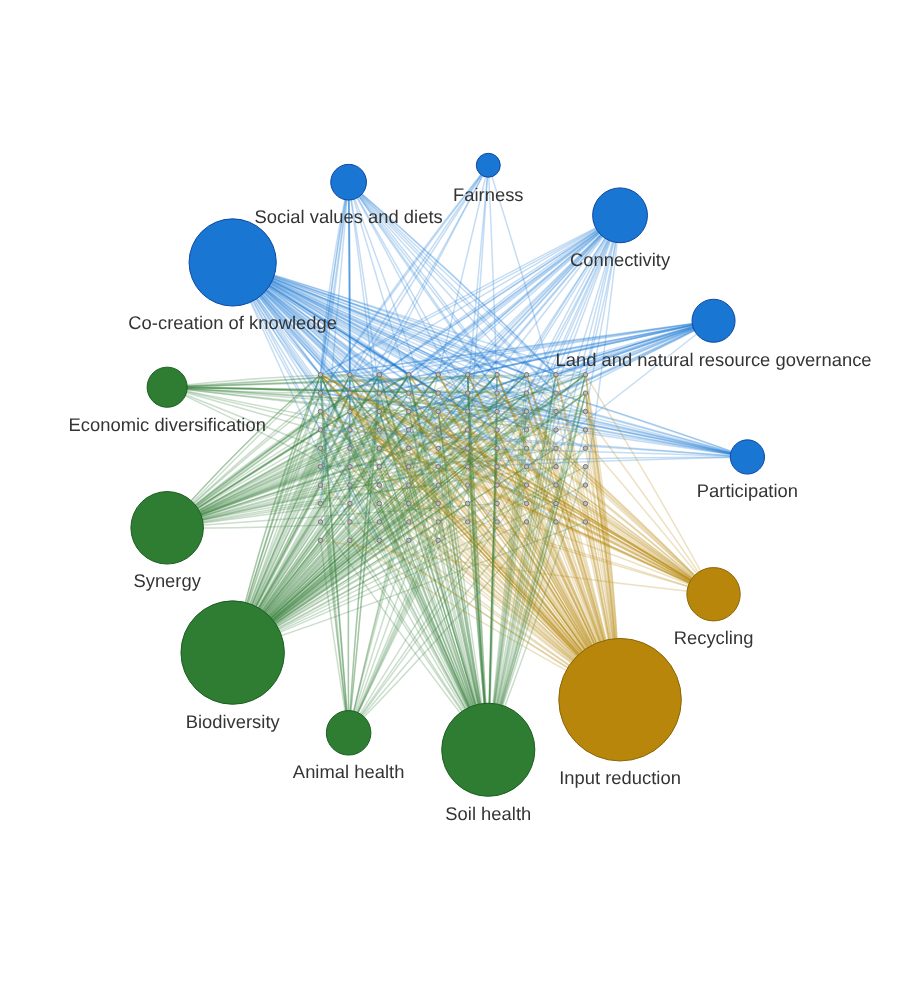
The mind-map of agroecological principles and installations interactions highlights clear asymmetries in how infrastructures are connected to different principles. Resource efficiency and ecological principles dominate the network: input reduction (n = 77) and biodiversity (n = 64) are the most frequently addressed, followed by soil health (n = 57) and co-creation of knowledge (n = 53). These findings confirm that infrastructures are strongly aligned with practices that optimize resource use and maintain ecological functions.
In contrast, principles that reflect social and governance dimensions are under-represented: economic diversification (n = 21), social values and diets (n = 18), participation (n = 17), and especially fairness (n = 10) appear as weakly connected nodes. This imbalance underscores that while infrastructures are well-positioned to deliver ecological benefits, they are less frequently mobilized to support social equity or participatory approaches, which are nonetheless central to the holistic implementation of agroecology.
- Strengthen Resilience
- Secure Social Equity
- Improve Resource Efficiency
- Installation
Coloured circles: principles, sized by the number of installations connected. Each line is one project linking an installation to a principle, coloured by the principle's cluster. Click a circle, or use the search box in the map, to highlight its connections.
 Tap to open the interactive map
Clusters of Agroecological Principles × Installations
Grouped into three clusters, Strengthen Resilience gathers the most links. Almost every installation reaches more than one cluster, but over a third of social equity links come from a single principle, co-creation of knowledge.
Share of the 468 installation–principle links, by cluster
Strengthen Resilience
209
links · 45% of all
- Biodiversity64
- Soil health57
- Synergy43
- Animal health24
- Economic diversification21
Secure Social Equity
152
links · 32% of all
- Co-creation of knowledge53
- Connectivity31
- Land and natural resource governance23
- Social values and diets18
- Participation17
- Fairness10
Improve Resource Efficiency
107
links · 23% of all
- Input reduction77
- Recycling30
How many clusters each installation reaches
Installations that reach several clusters act as bridges between ecological, efficiency and social dimensions.
- All three clusters51 / 95
- Two clusters40 / 95
- One cluster4 / 95
Read the full analysis
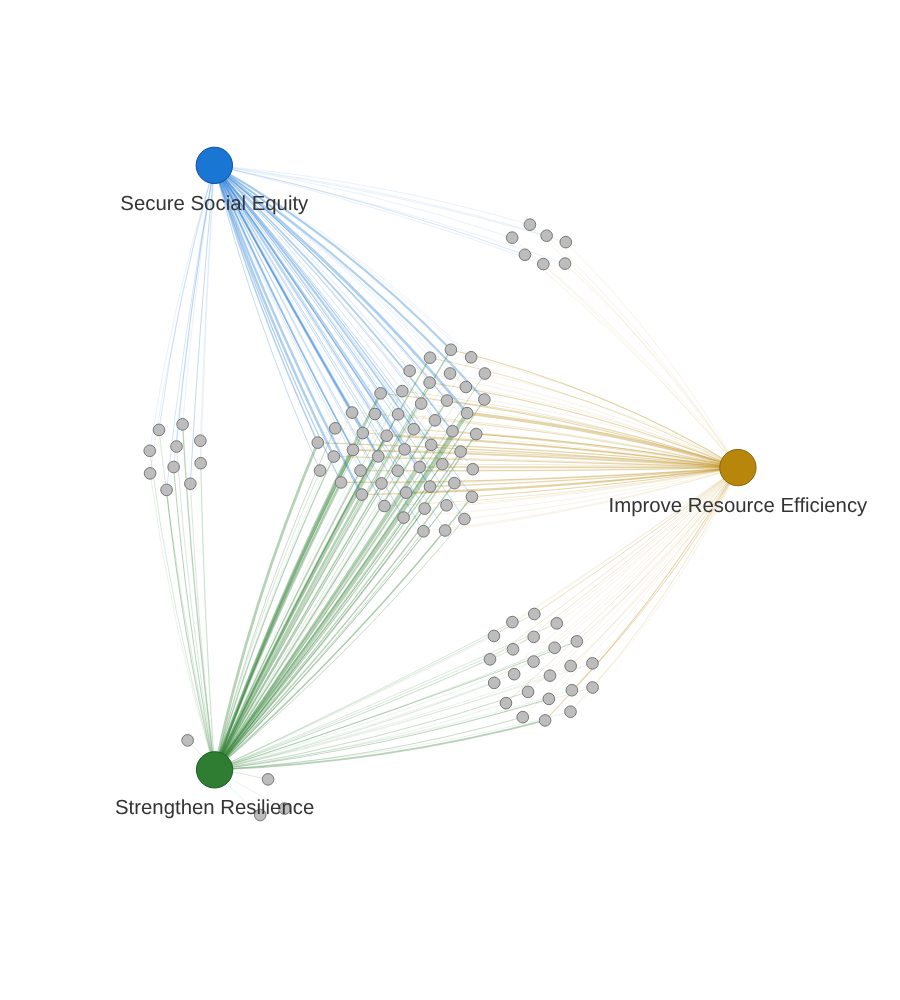
The cluster-level mind-map provides a more aggregated perspective, illustrating the distribution of all principle-level associations into three overarching dimensions. Strengthen Resilience is the most connected cluster with 209 associations, reflecting the central role of infrastructures in supporting biodiversity, soil health, and other resilience-enhancing principles. Secure Social Equity follows with 152 associations, a relatively high figure but largely concentrated in principles such as co-creation of knowledge, while fairness and participation remain marginal. Improve Resource Efficiency is the least connected cluster with 107 associations, dominated by input reduction and recycling.
An additional insight from this mind-map is the structural configuration of the network: several infrastructures serve as bridging nodes, linking simultaneously to more than one cluster, while many others connect to only a single dimension. This asymmetry suggests that the capacity to integrate ecological, efficiency, and social equity dimensions remains unevenly distributed across the research landscape. The visualization therefore highlights both opportunities and challenges: while certain infrastructures could act as strategic multipliers for multi-dimensional agroecological innovation, targeted support is required to strengthen connections to the Secure Social Equity cluster and to broaden the participation of less engaged infrastructures.
- Strengthen Resilience
- Secure Social Equity
- Improve Resource Efficiency
- Installation
Coloured circles: the three clusters. Line thickness shows how many project-level principle associations link an installation to a cluster. Click a circle, or use the search box in the map, to highlight its connections.
 Tap to open the interactive map
Explore an installation
See which principles each installation's projects addressed, and which are still open: a useful starting point for new proposals.
Pick an installation to see which principles its projects addressed, and which ones remain open.
Suggestions and Practical Use
For researchers
Identify which principles and clusters are most strongly connected to specific infrastructures, to design more targeted and interdisciplinary project proposals.
Explore an installationFor infrastructure managers
Benchmark your positioning: installations with weaker connections can spot under-represented principles (e.g., fairness, participation) where they may expand activities.
Check an installation's gapsFor policymakers and funding bodies
The data highlight systemic gaps, notably in Secure Social Equity, and can guide the design of future TNA calls to stimulate more balanced engagement across clusters.
See the cluster balanceFor the public and wider community
See how infrastructures contribute to agroecology, where innovation efforts are concentrated, and where further work is needed.
See the principles chart